2026
DeepSeek-V4: Towards Highly Efficient Million-Token Context Intelligence
DeepSeek-AI
Technical Report
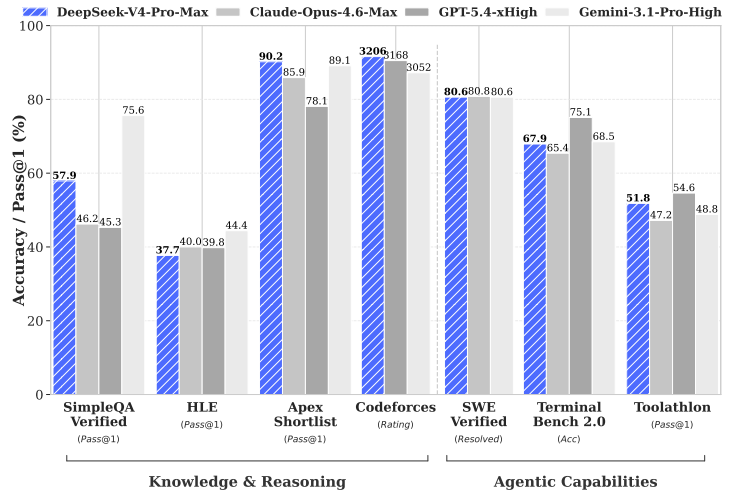
This report presents a preview version of DeepSeek-V4 series, including two strong Mixture-of-Experts (MoE) language models -- DeepSeek-V4-Pro with 1.6T parameters (49B activated) and DeepSeek-V4-Flash with 284B parameters (13B activated) -- both supporting a context length of one million tokens. DeepSeek-V4 series incorporate several key upgrades in architecture and optimization: (1) a hybrid attention architecture that combines Compressed Sparse Attention (CSA) and Heavily Compressed Attention (HCA) to improve long-context efficiency; (2) Manifold-Constrained Hyper-Connections (mHC) that enhance conventional residual connections; (3) and the Muon optimizer for faster convergence and greater training stability. We pre-train both models on more than 32T diverse and high-quality tokens, followed by a comprehensive post-training pipeline that unlocks and further enhances their capabilities. DeepSeek-V4-Pro-Max, the maximum reasoning effort mode of DeepSeek-V4-Pro, redefines the state-of-the-art for open models, outperforming its predecessors in core tasks. Meanwhile, DeepSeek-V4 series are highly efficient in long-context scenarios. In the one-million-token context setting, DeepSeek-V4-Pro requires only 27% of single-token inference FLOPs and 10% of KV cache compared with DeepSeek-V3.2. This enables us to routinely support one-million-token contexts, thereby making long-horizon tasks and further test-time scaling more feasible.
DeepSeek-V4: Towards Highly Efficient Million-Token Context Intelligence
DeepSeek-AI
Technical Report
This report presents a preview version of DeepSeek-V4 series, including two strong Mixture-of-Experts (MoE) language models -- DeepSeek-V4-Pro with 1.6T parameters (49B activated) and DeepSeek-V4-Flash with 284B parameters (13B activated) -- both supporting a context length of one million tokens. DeepSeek-V4 series incorporate several key upgrades in architecture and optimization: (1) a hybrid attention architecture that combines Compressed Sparse Attention (CSA) and Heavily Compressed Attention (HCA) to improve long-context efficiency; (2) Manifold-Constrained Hyper-Connections (mHC) that enhance conventional residual connections; (3) and the Muon optimizer for faster convergence and greater training stability. We pre-train both models on more than 32T diverse and high-quality tokens, followed by a comprehensive post-training pipeline that unlocks and further enhances their capabilities. DeepSeek-V4-Pro-Max, the maximum reasoning effort mode of DeepSeek-V4-Pro, redefines the state-of-the-art for open models, outperforming its predecessors in core tasks. Meanwhile, DeepSeek-V4 series are highly efficient in long-context scenarios. In the one-million-token context setting, DeepSeek-V4-Pro requires only 27% of single-token inference FLOPs and 10% of KV cache compared with DeepSeek-V3.2. This enables us to routinely support one-million-token contexts, thereby making long-horizon tasks and further test-time scaling more feasible.
UltraEP: Unleash MoE Training and Inference on Rack-Scale Nodes with Near-Optimal Load Balancing
Xinming Wei, Chao Jin, Tuo Dai, Yinmin Zhong, Shan Yu, Chengxu Yang, Bingyang Wu, Zili Zhang, Jing Mai, Qianchao Zhu, Zhouyang Li, Yuliang Liu, Guojie Luo
In preprint 2026
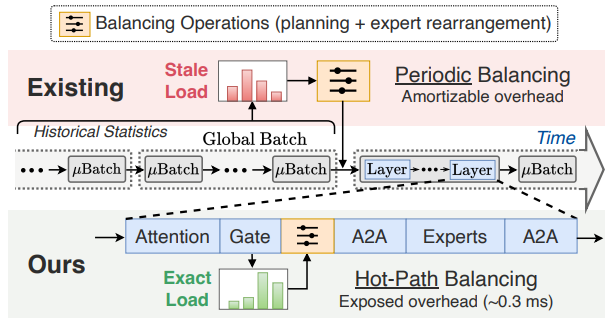
This work presents UltraEP, the first exact-load, real-time balancer for large-EP MoE training and serving prefill on rack-scale nodes (RSNs). Leveraging the extended scale-up connectivity among dozens of GPUs within RSNs, UltraEP rebalances every microbatch and layer on critical paths, which requires nontrivial co-design of plan solving and expert replication communication to minimize exposed overhead. To this end, UltraEP eagerly reacts to post-gating load with an efficient quota-driven planner, and executes the resulting irregular expert-state transfers with RSN-native persistent tile streaming and relay-based fan-out mitigation. We evaluate UltraEP in a multi-RSN deployment of up to 256 GPUs, using cutting-edge MoE models from 106B to 671B parameters.
UltraEP: Unleash MoE Training and Inference on Rack-Scale Nodes with Near-Optimal Load Balancing
Xinming Wei, Chao Jin, Tuo Dai, Yinmin Zhong, Shan Yu, Chengxu Yang, Bingyang Wu, Zili Zhang, Jing Mai, Qianchao Zhu, Zhouyang Li, Yuliang Liu, Guojie Luo
In preprint 2026
This work presents UltraEP, the first exact-load, real-time balancer for large-EP MoE training and serving prefill on rack-scale nodes (RSNs). Leveraging the extended scale-up connectivity among dozens of GPUs within RSNs, UltraEP rebalances every microbatch and layer on critical paths, which requires nontrivial co-design of plan solving and expert replication communication to minimize exposed overhead. To this end, UltraEP eagerly reacts to post-gating load with an efficient quota-driven planner, and executes the resulting irregular expert-state transfers with RSN-native persistent tile streaming and relay-based fan-out mitigation. We evaluate UltraEP in a multi-RSN deployment of up to 256 GPUs, using cutting-edge MoE models from 106B to 671B parameters.
ReLibra: Routing-Replay-Guided Load Balancing for MoE Training in Reinforcement Learning
Chao Jin, Xinming Wei, Yinmin Zhong, Chengxu Yang, Bingyang Wu, Ruidong Zhu, Zili Zhang, Yuliang Liu, Xin Jin
In preprint 2026
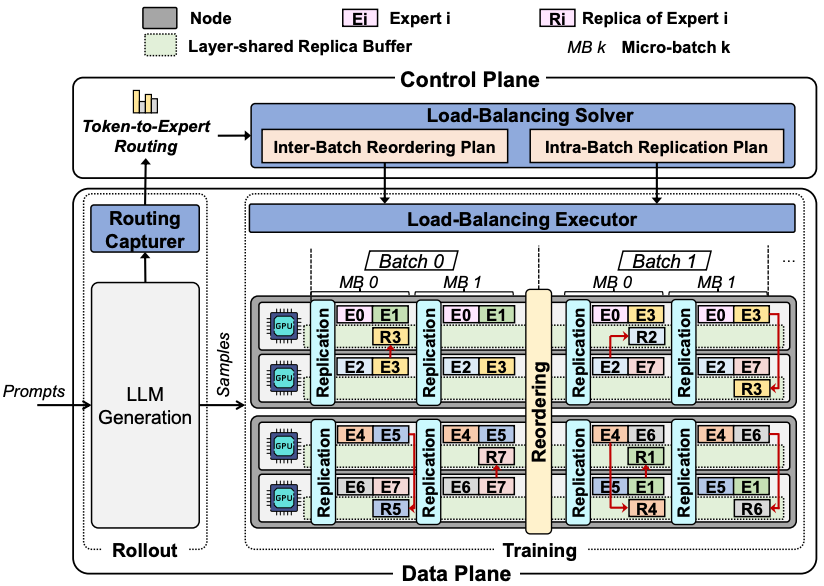
This work proposes ReLibra, an MoE RL training system that exploits a unique opportunity in RL's rollout-training workflow, routing replay, to enable fine-grained load balancing at micro-batch granularity. Because rollout and training process the same tokens with the same MoE parameters, the token-to-expert routing decisions are known before training starts. Leveraging this information, ReLibra places two MoE load-balancing mechanisms at inter- and intra-batch timescales, matching their communication patterns to hierarchical network bandwidths. At the inter-batch timescale, ReLibra performs expert reordering to redistribute experts for batch-level cross-node balancing; at the intra-batch timescale, it dynamically performs expert replication within a node to absorb micro-batch-level load fluctuations.
ReLibra: Routing-Replay-Guided Load Balancing for MoE Training in Reinforcement Learning
Chao Jin, Xinming Wei, Yinmin Zhong, Chengxu Yang, Bingyang Wu, Ruidong Zhu, Zili Zhang, Yuliang Liu, Xin Jin
In preprint 2026
This work proposes ReLibra, an MoE RL training system that exploits a unique opportunity in RL's rollout-training workflow, routing replay, to enable fine-grained load balancing at micro-batch granularity. Because rollout and training process the same tokens with the same MoE parameters, the token-to-expert routing decisions are known before training starts. Leveraging this information, ReLibra places two MoE load-balancing mechanisms at inter- and intra-batch timescales, matching their communication patterns to hierarchical network bandwidths. At the inter-batch timescale, ReLibra performs expert reordering to redistribute experts for batch-level cross-node balancing; at the intra-batch timescale, it dynamically performs expert replication within a node to absorb micro-batch-level load fluctuations.
FastServe: Iteration-Level Preemptive Scheduling for Large Language Model Inference
Bingyang Wu*, Yinmin Zhong*, Zili Zhang*, Gang Huang, Xuanzhe Liu, Xin Jin (* equal contribution)
Networking Systems Design and Implementation (NSDI) 2026
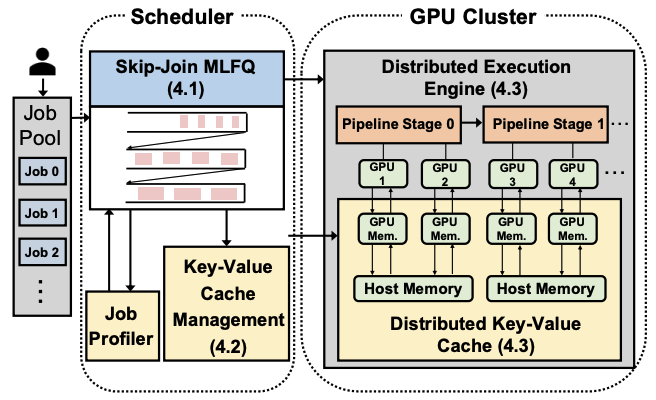
This paper presents FastServe, a distributed inference serving system for LLMs. FastServe exploits the autoregressive pattern of LLM inference to enable preemption at the granularity of each output token. FastServe uses preemptive scheduling to minimize JCT with a novel skip-join Multi-Level Feedback Queue scheduler.
FastServe: Iteration-Level Preemptive Scheduling for Large Language Model Inference
Bingyang Wu*, Yinmin Zhong*, Zili Zhang*, Gang Huang, Xuanzhe Liu, Xin Jin (* equal contribution)
Networking Systems Design and Implementation (NSDI) 2026
This paper presents FastServe, a distributed inference serving system for LLMs. FastServe exploits the autoregressive pattern of LLM inference to enable preemption at the granularity of each output token. FastServe uses preemptive scheduling to minimize JCT with a novel skip-join Multi-Level Feedback Queue scheduler.
DistRS: Disaggregated Reward Service for RLVR with Batch-Level Constraint
Ruidong Zhu, Mingcong Han, Yinmin Zhong, Wencong Xiao, Xuanzhe Liu, Xin Jin
Networking Systems Design and Implementation (NSDI) 2026
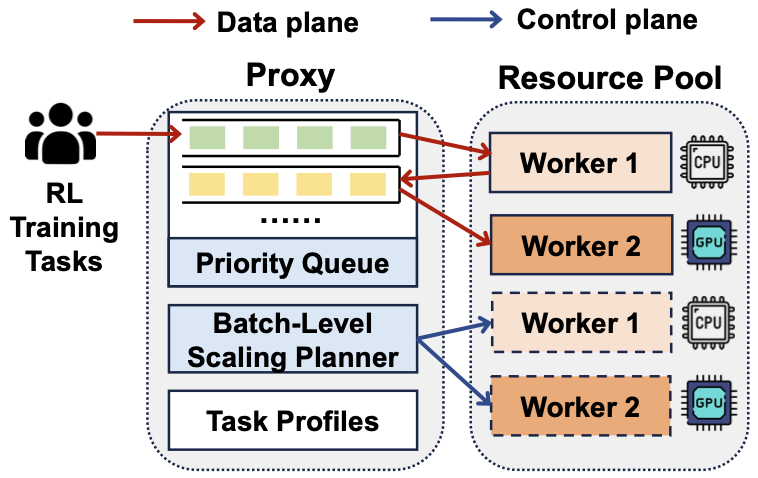
This paper presents DistRS, a reward service framework designed to provide resource-efficient reward computation for RLVR training tasks. DistRS establishes a batch-level constraint for each training task that relaxes latency requirements at the request level. Building on this foundation, we design a history-based resource scaling policy and a batch-level priority-based request scheduling policy.
DistRS: Disaggregated Reward Service for RLVR with Batch-Level Constraint
Ruidong Zhu, Mingcong Han, Yinmin Zhong, Wencong Xiao, Xuanzhe Liu, Xin Jin
Networking Systems Design and Implementation (NSDI) 2026
This paper presents DistRS, a reward service framework designed to provide resource-efficient reward computation for RLVR training tasks. DistRS establishes a batch-level constraint for each training task that relaxes latency requirements at the request level. Building on this foundation, we design a history-based resource scaling policy and a batch-level priority-based request scheduling policy.
Heddle: A Distributed Orchestration System for Agentic RL Rollout
Zili Zhang, Yinmin Zhong, Chengxu Yang, Chao Jin, Bingyang Wu, Xinming Wei, Yuliang Liu, Xin Jin
In preprint 2026
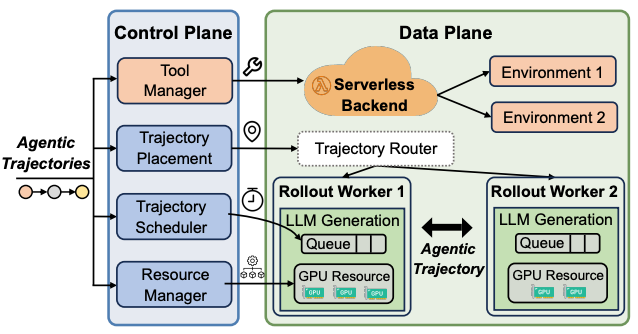
This work proposes Heddle, a trajectory-centric system to optimize the when, where, and how of agentic rollout execution. Heddle integrates three core mechanisms: trajectory-level scheduling using runtime prediction and progressive priority to minimize cumulative queueing; trajectory-aware placement via presorted dynamic programming and opportunistic migration during idle tool call intervals to minimize interference; and trajectory-adaptive resource manager that dynamically tunes model parallelism to accelerate the per-token time of long-tail trajectories while maintaining high throughput for short trajectories.
Heddle: A Distributed Orchestration System for Agentic RL Rollout
Zili Zhang, Yinmin Zhong, Chengxu Yang, Chao Jin, Bingyang Wu, Xinming Wei, Yuliang Liu, Xin Jin
In preprint 2026
This work proposes Heddle, a trajectory-centric system to optimize the when, where, and how of agentic rollout execution. Heddle integrates three core mechanisms: trajectory-level scheduling using runtime prediction and progressive priority to minimize cumulative queueing; trajectory-aware placement via presorted dynamic programming and opportunistic migration during idle tool call intervals to minimize interference; and trajectory-adaptive resource manager that dynamically tunes model parallelism to accelerate the per-token time of long-tail trajectories while maintaining high throughput for short trajectories.
2025
DeepSeek-V3.2: Pushing the Frontier of Open Large Language Models
DeepSeek-AI
Technical Report
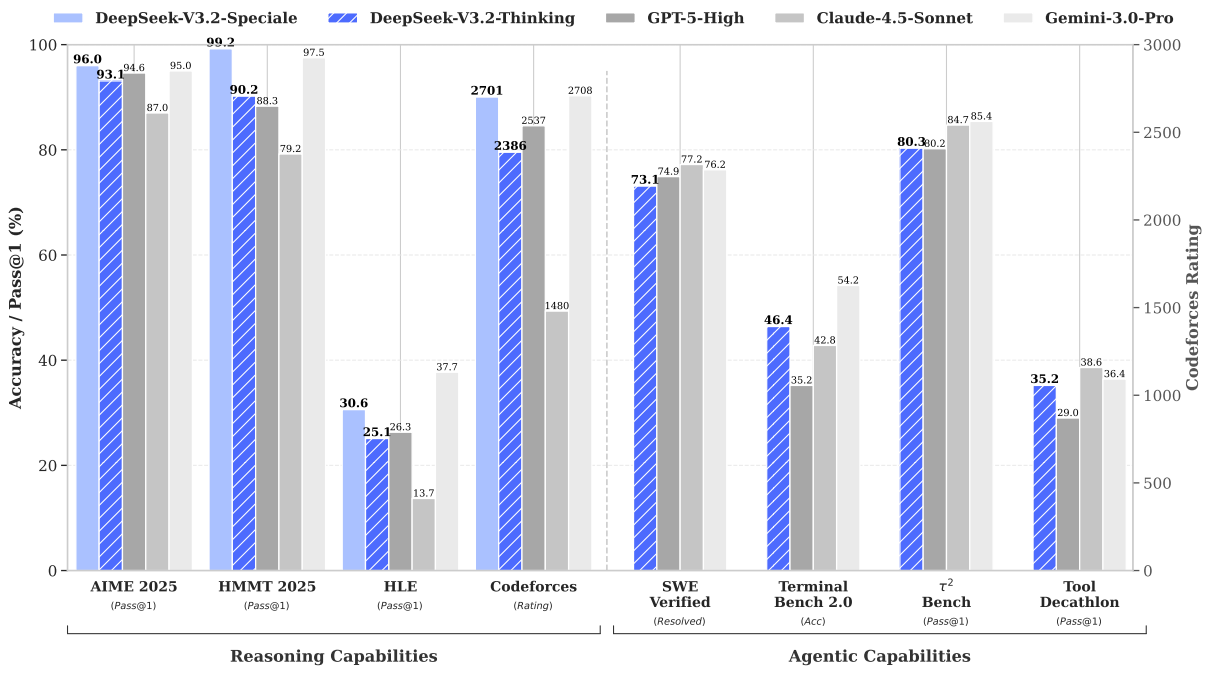
This report introduces DeepSeek-V3.2, a model that harmonizes high computational efficiency with superior reasoning and agent performance. The key technical breakthroughs of DeepSeek-V3.2 are as follows: (1) DeepSeek Sparse Attention (DSA): We introduce DSA, an efficient attention mechanism that substantially reduces computational complexity while preserving model performance in long-context scenarios. (2) Scalable Reinforcement Learning Framework: By implementing a robust reinforcement learning protocol and scaling post-training compute, DeepSeek-V3.2 performs comparably to GPT-5. Notably, our high-compute variant, DeepSeek-V3.2-Speciale, surpasses GPT-5 and exhibits reasoning proficiency on par with Gemini-3.0-Pro, achieving gold-medal performance in both the 2025 International Mathematical Olympiad (IMO) and the International Olympiad in Informatics (IOI). (3) Large-Scale Agentic Task Synthesis Pipeline: To integrate reasoning into tool-use scenarios, we developed a novel synthesis pipeline that systematically generates training data at scale. This methodology facilitates scalable agentic post-training, yielding substantial improvements in generalization and instruction-following robustness within complex, interactive environments.
DeepSeek-V3.2: Pushing the Frontier of Open Large Language Models
DeepSeek-AI
Technical Report
This report introduces DeepSeek-V3.2, a model that harmonizes high computational efficiency with superior reasoning and agent performance. The key technical breakthroughs of DeepSeek-V3.2 are as follows: (1) DeepSeek Sparse Attention (DSA): We introduce DSA, an efficient attention mechanism that substantially reduces computational complexity while preserving model performance in long-context scenarios. (2) Scalable Reinforcement Learning Framework: By implementing a robust reinforcement learning protocol and scaling post-training compute, DeepSeek-V3.2 performs comparably to GPT-5. Notably, our high-compute variant, DeepSeek-V3.2-Speciale, surpasses GPT-5 and exhibits reasoning proficiency on par with Gemini-3.0-Pro, achieving gold-medal performance in both the 2025 International Mathematical Olympiad (IMO) and the International Olympiad in Informatics (IOI). (3) Large-Scale Agentic Task Synthesis Pipeline: To integrate reasoning into tool-use scenarios, we developed a novel synthesis pipeline that systematically generates training data at scale. This methodology facilitates scalable agentic post-training, yielding substantial improvements in generalization and instruction-following robustness within complex, interactive environments.
Efficient RL for LLMs with Dynamic and Online Speculative Decoding
Chao Jin, Yinmin Zhong, Zili Zhang, Yimin Jiang, Yibo Zhu
The 1st Frontier AI Systems Workshop (FAISys) 2025
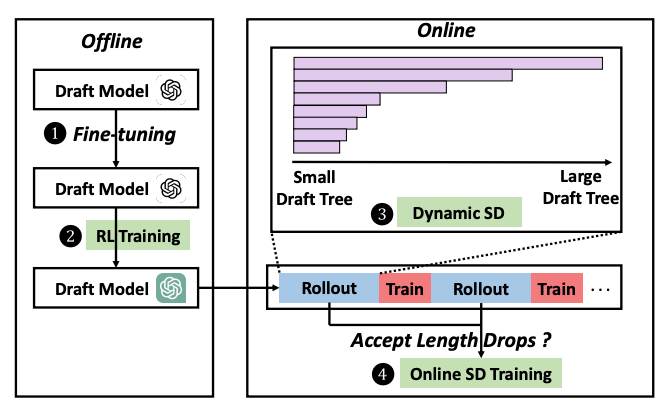
This work presents SpecRL, extending speculative decoding into a dynamic, online approach that allows for real-time adjustments based on the evolving state of the rollout process. Our method dynamically adapts the speculative decoding strategy in response to the current system load and periodically updates the draft model to maintain alignment with the target model’s evolving parameters.
Efficient RL for LLMs with Dynamic and Online Speculative Decoding
Chao Jin, Yinmin Zhong, Zili Zhang, Yimin Jiang, Yibo Zhu
The 1st Frontier AI Systems Workshop (FAISys) 2025
This work presents SpecRL, extending speculative decoding into a dynamic, online approach that allows for real-time adjustments based on the evolving state of the rollout process. Our method dynamically adapts the speculative decoding strategy in response to the current system load and periodically updates the draft model to maintain alignment with the target model’s evolving parameters.
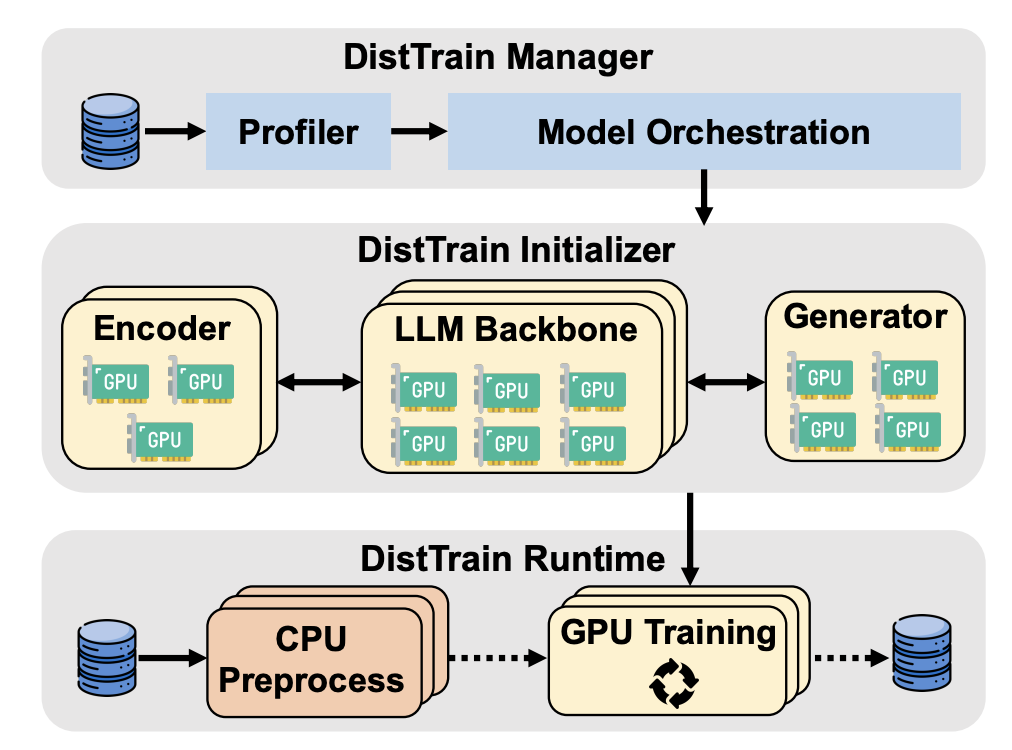
DistTrain: Addressing Model and Data Heterogeneity with Disaggregated Training for Multimodal Large Language Models
Zili Zhang, Yinmin Zhong, Ranchen Ming, Hanpeng Hu, Jianjian Sun, Zheng Ge, Yibo Zhu, Xin Jin
ACM Special Interest Group on Data Communication (SIGCOMM) 2025
This work presents DistTrain, an efficient and adaptive framework to reform the training of multimodal large language models on large-scale clusters. The core of DistTrain is the disaggregated training technique that exploits the characteristics of multimodal LLM training to achieve high efficiency and scalability. Specifically, it leverages disaggregated model orchestration and disaggregated data reordering to address model and data heterogeneity respectively.
DistTrain: Addressing Model and Data Heterogeneity with Disaggregated Training for Multimodal Large Language Models
Zili Zhang, Yinmin Zhong, Ranchen Ming, Hanpeng Hu, Jianjian Sun, Zheng Ge, Yibo Zhu, Xin Jin
ACM Special Interest Group on Data Communication (SIGCOMM) 2025
This work presents DistTrain, an efficient and adaptive framework to reform the training of multimodal large language models on large-scale clusters. The core of DistTrain is the disaggregated training technique that exploits the characteristics of multimodal LLM training to achieve high efficiency and scalability. Specifically, it leverages disaggregated model orchestration and disaggregated data reordering to address model and data heterogeneity respectively.
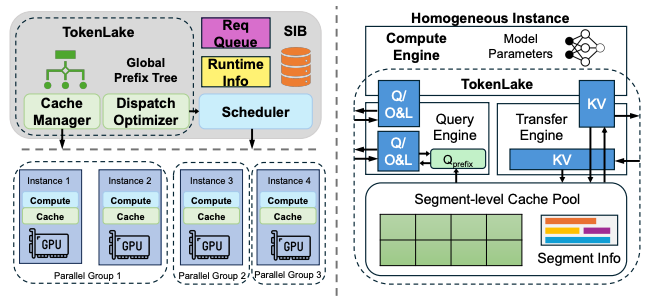
TokenLake: A Unified Segment-level Prefix Cache Pool for Fine-grained Elastic Long-Context LLM Serving
Bingyang Wu, Zili Zhang, Yinmin Zhong, Guanzhe Huang, Yibo Zhu, Xuanzhe Liu, Xin Jin
In preprint 2025
This work presents TokenLake, which uses a declarative cache interface to expose requests' query tensors, prefix caches, and cache-aware operations for efficient pooling. Powered by this abstraction, TokenLake can manage prefix cache at the segment level with a heavy-hitter-aware load balancing algorithm to achieve better cache load balance, deduplication, and defragmentation. TokenLake also transparently minimizes the communication volume of query tensors and new caches. Based on TokenLake, the scheduler can schedule requests elastically by using existing techniques without considering prefix cache management.
TokenLake: A Unified Segment-level Prefix Cache Pool for Fine-grained Elastic Long-Context LLM Serving
Bingyang Wu, Zili Zhang, Yinmin Zhong, Guanzhe Huang, Yibo Zhu, Xuanzhe Liu, Xin Jin
In preprint 2025
This work presents TokenLake, which uses a declarative cache interface to expose requests' query tensors, prefix caches, and cache-aware operations for efficient pooling. Powered by this abstraction, TokenLake can manage prefix cache at the segment level with a heavy-hitter-aware load balancing algorithm to achieve better cache load balance, deduplication, and defragmentation. TokenLake also transparently minimizes the communication volume of query tensors and new caches. Based on TokenLake, the scheduler can schedule requests elastically by using existing techniques without considering prefix cache management.
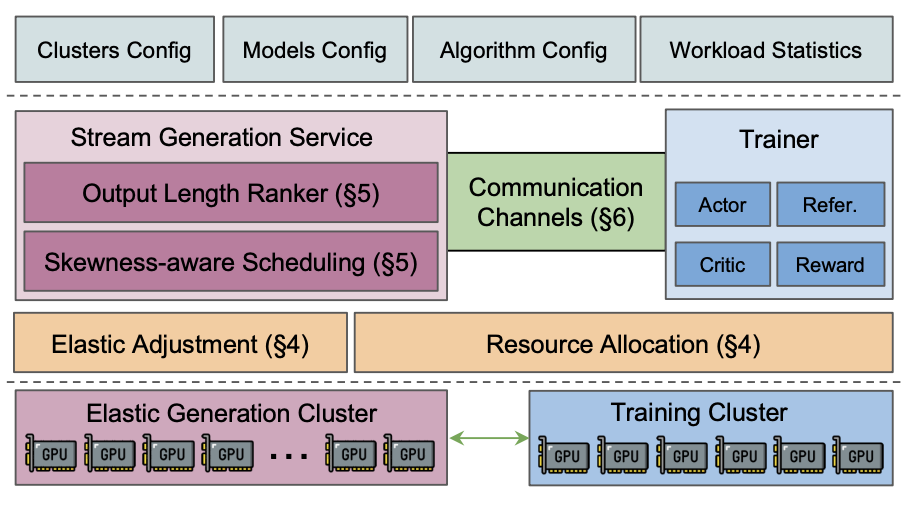
StreamRL: Scalable, Heterogeneous, and Elastic RL for LLMs with Disaggregated Stream Generation
Yinmin Zhong, Zili Zhang, Xiaoniu Song, Hanpeng Hu, Chao Jin, Bingyang Wu, Nuo Chen, Yukun Chen, Yu Zhou, Changyi Wan, Hongyu Zhou, Yimin Jiang, Yibo Zhu, Daxin Jiang
In preprint 2025
StreamRL is designed with disaggregation from first principles and fully unlocks its potential by addressing two types of performance bottlenecks in existing disaggregated RL frameworks: pipeline bubbles, caused by stage dependencies, and skewness bubbles, resulting from long-tail output length distributions. To address pipeline bubbles, StreamRL breaks the traditional stage boundary in synchronous RL algorithms through stream generation and achieves full overlapping in asynchronous RL. To address skewness bubbles, StreamRL employs an output-length ranker model to identify long-tail samples and reduces generation time via skewness-aware dispatching.
StreamRL: Scalable, Heterogeneous, and Elastic RL for LLMs with Disaggregated Stream Generation
Yinmin Zhong, Zili Zhang, Xiaoniu Song, Hanpeng Hu, Chao Jin, Bingyang Wu, Nuo Chen, Yukun Chen, Yu Zhou, Changyi Wan, Hongyu Zhou, Yimin Jiang, Yibo Zhu, Daxin Jiang
In preprint 2025
StreamRL is designed with disaggregation from first principles and fully unlocks its potential by addressing two types of performance bottlenecks in existing disaggregated RL frameworks: pipeline bubbles, caused by stage dependencies, and skewness bubbles, resulting from long-tail output length distributions. To address pipeline bubbles, StreamRL breaks the traditional stage boundary in synchronous RL algorithms through stream generation and achieves full overlapping in asynchronous RL. To address skewness bubbles, StreamRL employs an output-length ranker model to identify long-tail samples and reduces generation time via skewness-aware dispatching.
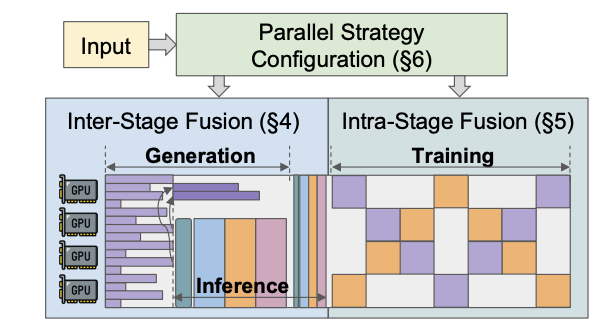
Optimizing RLHF Training for Large Language Models with Stage Fusion
Yinmin Zhong, Zili Zhang, Bingyang Wu, Shengyu Liu, Yukun Chen, Changyi Wan, Hanpeng Hu, Lei Xia, Ranchen Ming, Yibo Zhu, Xin Jin
Networking Systems Design and Implementation (NSDI) 2025
This work presents RLHFuse, an efficient RLHF training system which views the RLHF workflow from a finer-grained subtask-level perspective and opens up opportunities for efficient inter- and intra-stage fused execution, mitigating data skewness and pipeline bubbles in existing systems.
Optimizing RLHF Training for Large Language Models with Stage Fusion
Yinmin Zhong, Zili Zhang, Bingyang Wu, Shengyu Liu, Yukun Chen, Changyi Wan, Hanpeng Hu, Lei Xia, Ranchen Ming, Yibo Zhu, Xin Jin
Networking Systems Design and Implementation (NSDI) 2025
This work presents RLHFuse, an efficient RLHF training system which views the RLHF workflow from a finer-grained subtask-level perspective and opens up opportunities for efficient inter- and intra-stage fused execution, mitigating data skewness and pipeline bubbles in existing systems.
2024
LoongServe: Efficiently Serving Long-context Large Language Models with Elastic Sequence Parallelism
Bingyang Wu, Shengyu Liu, Yinmin Zhong, Peng Sun, Xuanzhe Liu, Xin Jin
Symposium on Operating Systems Principles (SOSP) 2024
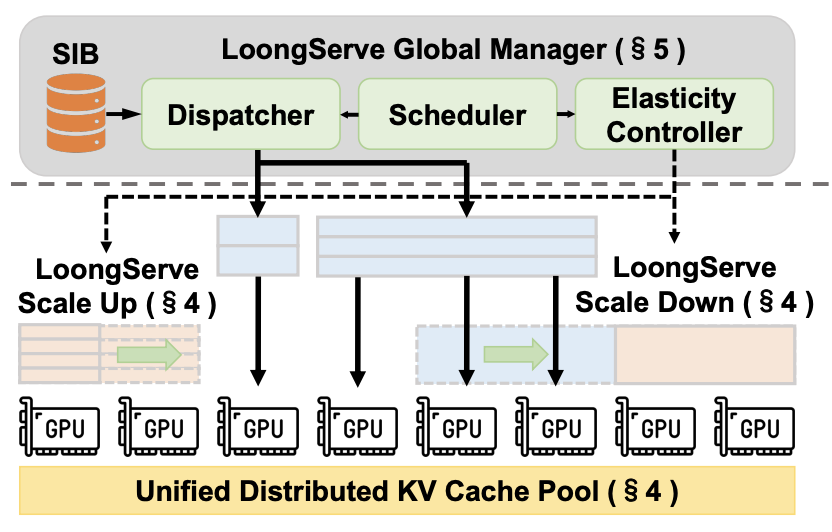
This paper propose a new parallelism paradigm, elastic sequence parallelism (ESP), to elastically adapt to the variance between different requests and phases. Based on ESP, we design and build LoongServe, an LLM serving system that (1) improves computation efficiency by elastically adjusting the degree of parallelism in real-time, (2) improves communication efficiency by reducing key-value cache migration overhead and overlapping partial decoding communication with computation, and (3) improves GPU memory efficiency by reducing key-value cache fragmentation across instances.
LoongServe: Efficiently Serving Long-context Large Language Models with Elastic Sequence Parallelism
Bingyang Wu, Shengyu Liu, Yinmin Zhong, Peng Sun, Xuanzhe Liu, Xin Jin
Symposium on Operating Systems Principles (SOSP) 2024
This paper propose a new parallelism paradigm, elastic sequence parallelism (ESP), to elastically adapt to the variance between different requests and phases. Based on ESP, we design and build LoongServe, an LLM serving system that (1) improves computation efficiency by elastically adjusting the degree of parallelism in real-time, (2) improves communication efficiency by reducing key-value cache migration overhead and overlapping partial decoding communication with computation, and (3) improves GPU memory efficiency by reducing key-value cache fragmentation across instances.
DistServe: Disaggregating Prefill and Decoding for Goodput-optimized Large Language Model Serving
Yinmin Zhong, Shengyu Liu, Junda Chen, Jianbo Hu, Yibo Zhu, Xuanzhe Liu, Xin Jin, Hao Zhang
Operating Systems Design and Implementation (OSDI) 2024
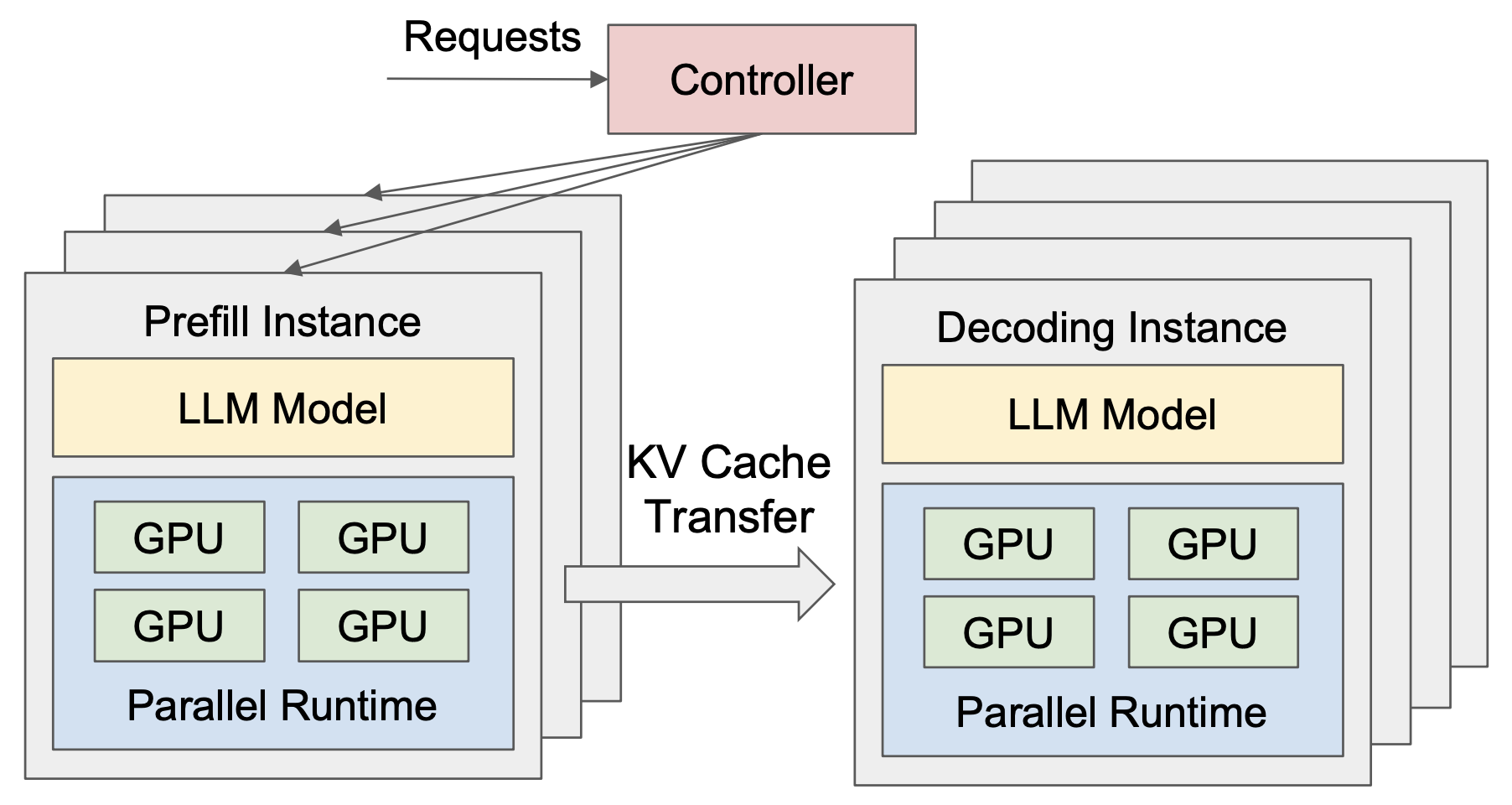
DistServe improves the performance of large language models (LLMs) serving by disaggregating the prefill and decoding computation. Given the application latency requirements, DistServe co-optimizes the resource allocation and parallelism strategy tailored for each phase.
DistServe: Disaggregating Prefill and Decoding for Goodput-optimized Large Language Model Serving
Yinmin Zhong, Shengyu Liu, Junda Chen, Jianbo Hu, Yibo Zhu, Xuanzhe Liu, Xin Jin, Hao Zhang
Operating Systems Design and Implementation (OSDI) 2024
DistServe improves the performance of large language models (LLMs) serving by disaggregating the prefill and decoding computation. Given the application latency requirements, DistServe co-optimizes the resource allocation and parallelism strategy tailored for each phase.
MegaScale: Scaling Large Language Model Training to More Than 10,000 GPUs
Ziheng Jiang*, Haibin Lin*, Yinmin Zhong*, Qi Huang, Yangrui Chen, Zhi Zhang, Yanghua Peng, Xiang Li, Cong Xie, Shibiao Nong, Yulu Jia, Sun He, Hongmin Chen, Zhihao Bai, Qi Hou, Shipeng Yan, Ding Zhou, Yiyao Sheng, Zhuo Jiang, Haohan Xu, Haoran Wei, Zhang Zhang, Pengfei Nie, Leqi Zou, Sida Zhao, Liang Xiang, Zherui Liu, Zhe Li, Xiaoying Jia, Jianxi Ye, Xin Jin, Xin Liu (* equal contribution)
Networking Systems Design and Implementation (NSDI) 2024
This paper presents the design, implementation and engineering experience in building and deploying Megascale, a production system for training large language models (LLMs) at the scale of more than 10,000 GPUs.
MegaScale: Scaling Large Language Model Training to More Than 10,000 GPUs
Ziheng Jiang*, Haibin Lin*, Yinmin Zhong*, Qi Huang, Yangrui Chen, Zhi Zhang, Yanghua Peng, Xiang Li, Cong Xie, Shibiao Nong, Yulu Jia, Sun He, Hongmin Chen, Zhihao Bai, Qi Hou, Shipeng Yan, Ding Zhou, Yiyao Sheng, Zhuo Jiang, Haohan Xu, Haoran Wei, Zhang Zhang, Pengfei Nie, Leqi Zou, Sida Zhao, Liang Xiang, Zherui Liu, Zhe Li, Xiaoying Jia, Jianxi Ye, Xin Jin, Xin Liu (* equal contribution)
Networking Systems Design and Implementation (NSDI) 2024
This paper presents the design, implementation and engineering experience in building and deploying Megascale, a production system for training large language models (LLMs) at the scale of more than 10,000 GPUs.
DistMind: Efficient Resource Disaggregation for Deep Learning Workloads
Xin Jin, Zhihao Bai, Zhen Zhang, Yibo Zhu, Yinmin Zhong, Xuanzhe Liu
Transactions on Networking (TON) 2024
Deep learning (DL) systems suffer from low resource utilization due to (i) the monolithic server model that tightly couples compute and memory, and (ii) the limited sharing between different inference applications, and across inference and training, because of strict service level objectives (SLOs). To address this problem, we present DistMind, a disaggregated DL system that enables efficient multiplexing of DL applications with near- optimal resource utilization. DistMind decouples compute from host memory, and exposes the abstractions of a GPU pool and a memory pool, each of which can be independently provisioned.
DistMind: Efficient Resource Disaggregation for Deep Learning Workloads
Xin Jin, Zhihao Bai, Zhen Zhang, Yibo Zhu, Yinmin Zhong, Xuanzhe Liu
Transactions on Networking (TON) 2024
Deep learning (DL) systems suffer from low resource utilization due to (i) the monolithic server model that tightly couples compute and memory, and (ii) the limited sharing between different inference applications, and across inference and training, because of strict service level objectives (SLOs). To address this problem, we present DistMind, a disaggregated DL system that enables efficient multiplexing of DL applications with near- optimal resource utilization. DistMind decouples compute from host memory, and exposes the abstractions of a GPU pool and a memory pool, each of which can be independently provisioned.
2023
AlpaServe: Statistical Multiplexing with Model Parallelism for Deep Learning Serving
Zhuohan Li*, Lianmin Zheng*, Yinmin Zhong*, Vincent Liu, Ying Sheng, Xin Jin, Yanping Huang, Zhifeng Chen, Hao Zhang, Joseph E. Gonzalez, Ion Stoica (* equal contribution)
Operating Systems Design and Implementation (OSDI) 2023
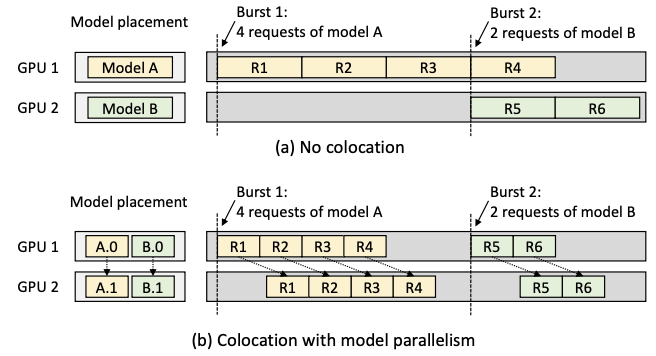
This paper presents AlpaServe, a system for inference servings of multiple large deep-learning models. AlpaServe demonstrates that model parallelism is useful for many other scenarios, quantifies the tradeoffs, and presents techniques to automatically navigate that tradeoff space.
AlpaServe: Statistical Multiplexing with Model Parallelism for Deep Learning Serving
Zhuohan Li*, Lianmin Zheng*, Yinmin Zhong*, Vincent Liu, Ying Sheng, Xin Jin, Yanping Huang, Zhifeng Chen, Hao Zhang, Joseph E. Gonzalez, Ion Stoica (* equal contribution)
Operating Systems Design and Implementation (OSDI) 2023
This paper presents AlpaServe, a system for inference servings of multiple large deep-learning models. AlpaServe demonstrates that model parallelism is useful for many other scenarios, quantifies the tradeoffs, and presents techniques to automatically navigate that tradeoff space.
ElasticFlow: An Elastic Serverless Training Platform for Distributed Deep Learning
Diandian Gu, Yihao Zhao, Yinmin Zhong, Yifan Xiong, Zhenhua Han, Peng Cheng, Fan Yang, Gang Huang, Xin Jin, Xuanzhe Liu
Architectural Support for Programming Languages and Operating Systems (ASPLOS) 2023
This paper proposes ElasticFlow, an elastic serverless training platform for distributed deep learning. ElasticFlow provides a serverless interface with two distinct features: (i) users specify only the deep neural network (DNN) model and hyperparameters for a job, but not the number of GPUs; (ii) users specify the deadline for a job, but not the amount of time to occupy GPUs.
ElasticFlow: An Elastic Serverless Training Platform for Distributed Deep Learning
Diandian Gu, Yihao Zhao, Yinmin Zhong, Yifan Xiong, Zhenhua Han, Peng Cheng, Fan Yang, Gang Huang, Xin Jin, Xuanzhe Liu
Architectural Support for Programming Languages and Operating Systems (ASPLOS) 2023
This paper proposes ElasticFlow, an elastic serverless training platform for distributed deep learning. ElasticFlow provides a serverless interface with two distinct features: (i) users specify only the deep neural network (DNN) model and hyperparameters for a job, but not the number of GPUs; (ii) users specify the deadline for a job, but not the amount of time to occupy GPUs.